Case Study: Product Design & AI Build
Bentley Markets: private crypto intelligence
Overview
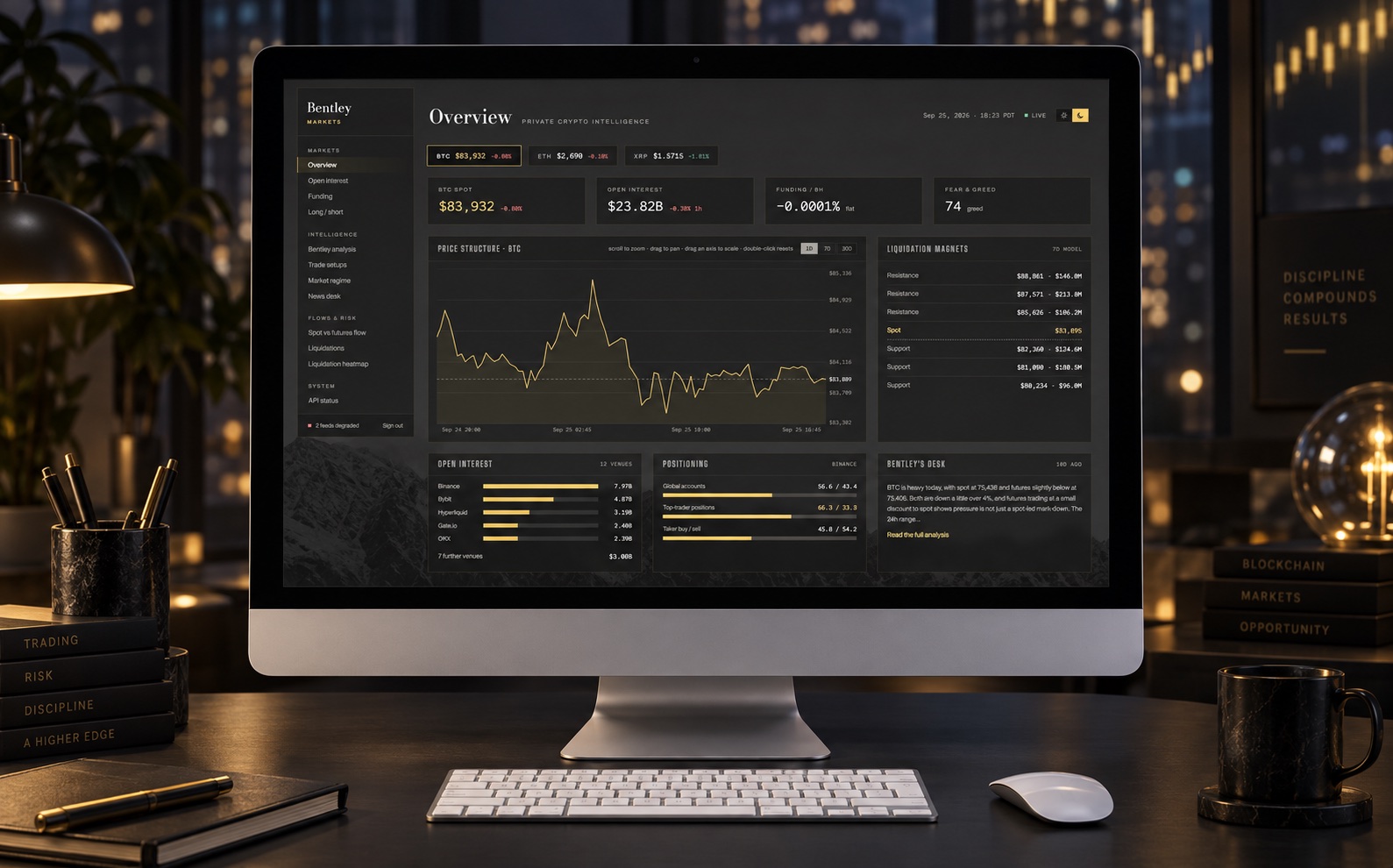
Trading crypto well means watching a lot at once: price, funding, open interest, who is long and who is short, where the liquidations sit, what the order flow is doing on spot versus futures. Nobody can hold all of that across three coins and seventeen exchanges at 3am.
Bentley does the watching. It gathers the data, an AI agent turns it into a written read and a small number of concrete trade setups, each with an entry zone, a stop, targets and a score out of 100. When a setup clears the bar I set, Bentley takes the trade itself.
The same order path works in two places. Pointed at the paper account, every trade is simulated against live prices so a strategy can prove itself with no money at risk. Given an exchange API key, it places real orders on a funded account.
My Role
Solo Designer & Builder
Product thinking, UX, UI, the design system, the backend, the agent's prompts and guardrails, and the server
Timeline
Spring 2026 to Now
Started in the spring, moved onto its own server in July, setup-driven trading from early September, still evolving
The Brain
Hermes Agent, on ChatGPT
A Hermes AI agent with the persona Bentley, running OpenAI's GPT-5.5 through ChatGPT
Inputs
Market Structure & On-Chain
Spot and futures prices, funding, open interest, long/short ratios, taker flow, liquidations, sentiment
Output
Trade Setups, Then Trades
Written analysis, scored setups with entry, stop and targets, and automatic execution
Execution
Paper or Live
A simulated account for testing, or a funded exchange account connected by API key
How It Works
Bentley is a loop. Each stage hands the next one something smaller and more decided, and a person can step in at any point.
Collect
Background jobs poll Binance, Bybit, OKX, Hyperliquid, Deribit, Coinbase, Kraken and more for prices, funding, open interest, positioning and trade flow, plus on-chain and sentiment feeds. The data is refreshed every 25 seconds so the screen never waits on it.
Read
Before the AI sees anything, the server works out the hard numbers itself: RSI on the 1h and 4h, ATR, moving averages, swing highs and lows, and the 24h, 7d and 30d ranges. The model reasons over facts rather than guessing at them.
Write
Bentley, the Hermes agent, gets the whole picture and returns strict JSON: at most two setups per coin, each with an entry zone, a structure-based stop, targets at 1.5 to 3.5 times the risk, a rationale and the condition that kills the idea. No setup is a valid answer.
Score
Each setup carries the agent's own score out of 100. Separately, the server computes a market score from live data: funding, crowding, open interest change, taker flow and whether venues agree. A trade needs both.
Execute
A worker checks every setup each tick. If both scores clear my minimums and price is inside the entry zone, it opens the position, sized by the share of the account and the leverage I set per coin, and exits on the setup's own stop or target.
Report
Every open trade, closed trade and blocked trade is on screen with the reason. Bentley also messages me on Telegram, and I can ask it questions there or by voice on its command deck.
Trade Setups
The first version of the setups page showed five equal boxes of numbers. It was all correct and none of it answered the only question that matters when you open it: can I act on this right now?
The redesign weights the entry zone above the stop and targets, and adds a price ladder: a single line from stop to target with the entry zone shaded and a marker for where price is now. A state chip reads Armed, Waiting or Entry missed, so a stale idea says so instead of looking tradeable.
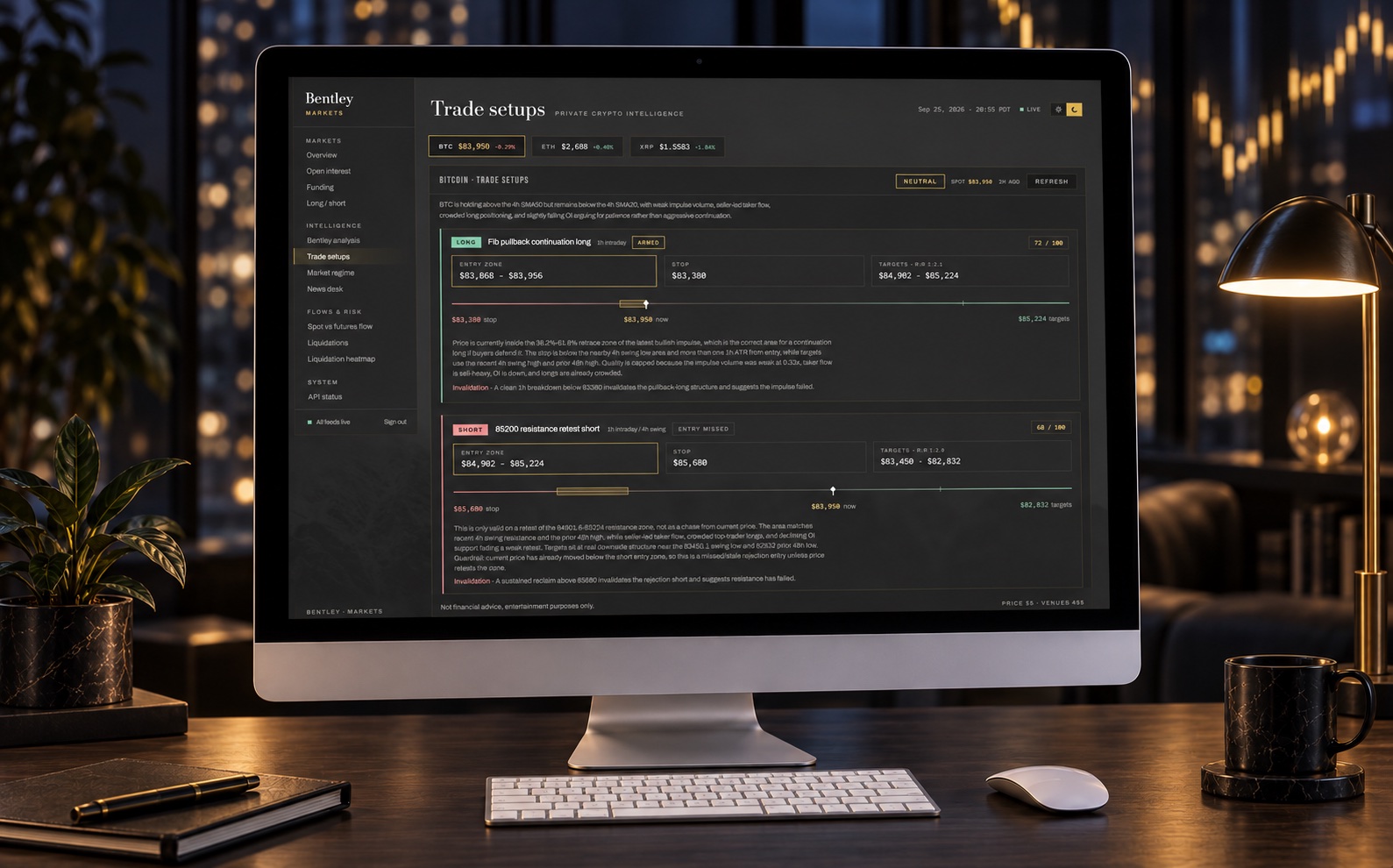
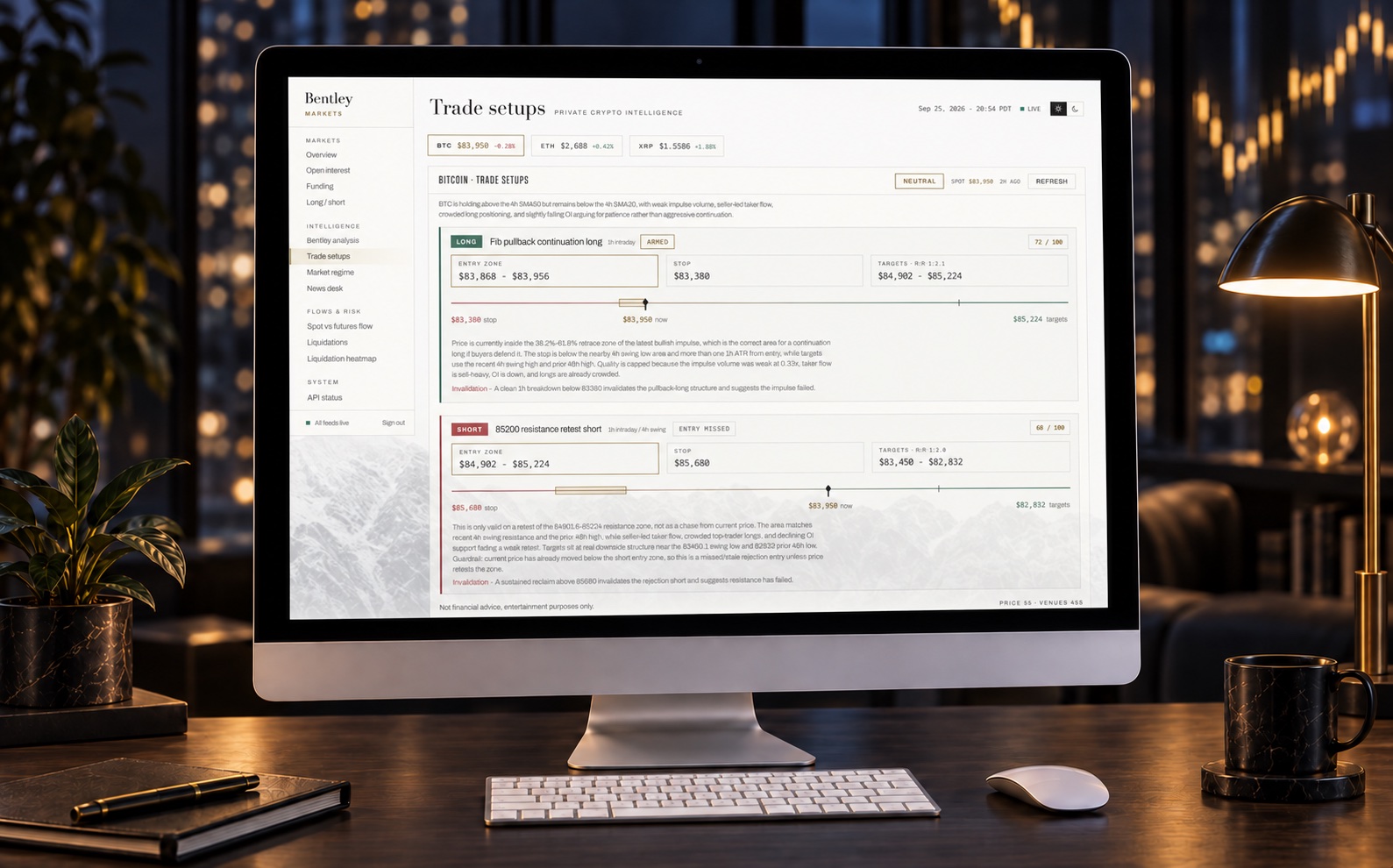
The ladder is drawn in the browser from the live price, so it moves with the market between AI refreshes. You see instantly whether price is in the zone, short of it, or past it.
Every setup ends with its invalidation in plain words, like "a clean 1h breakdown below 83380". Knowing when an idea is wrong matters more than knowing when it is right.
Market Regime
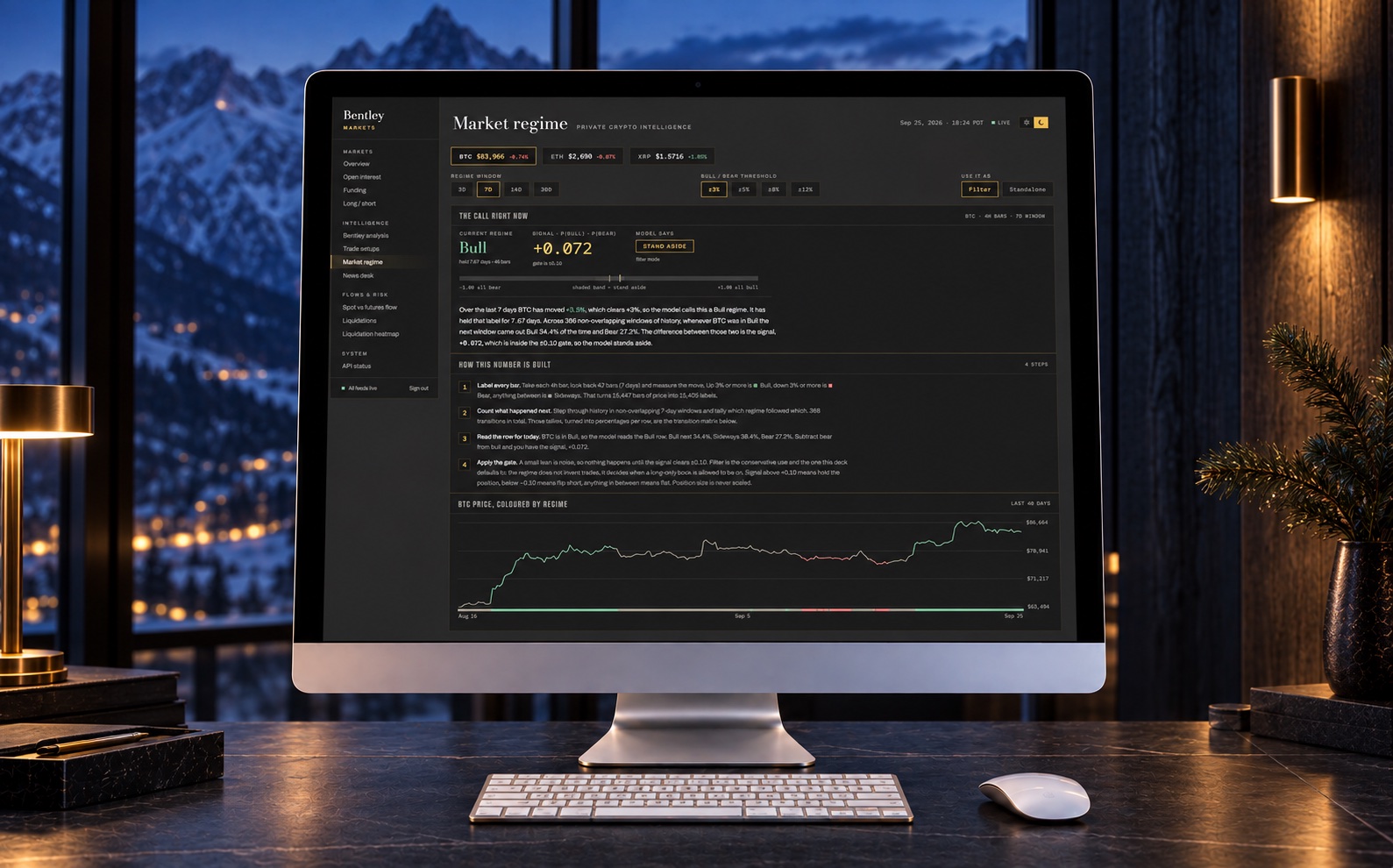
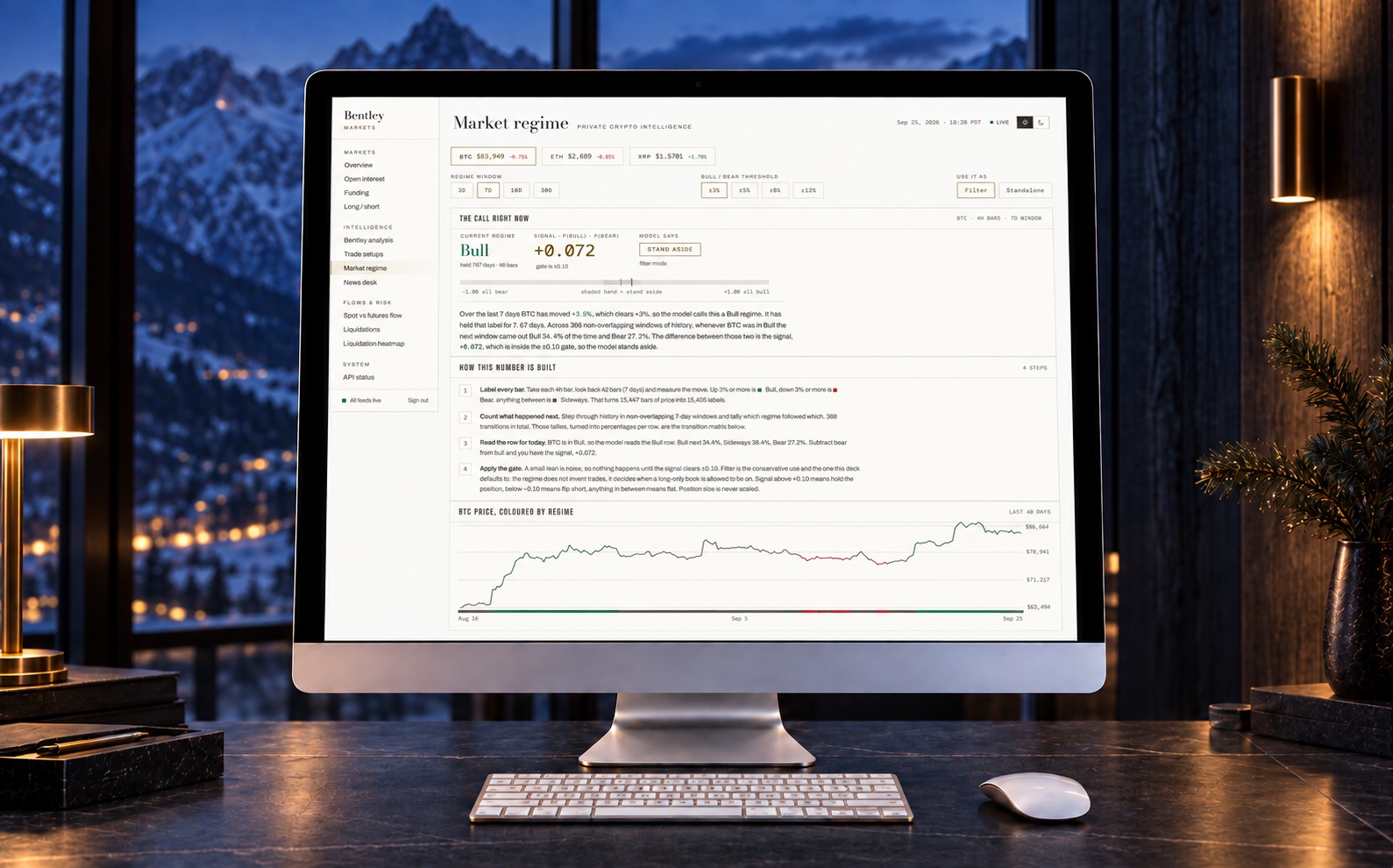
Good setups lose money in the wrong market. The regime view labels every 4-hour bar of Bitcoin's history as Bull, Bear or Sideways, counts what tended to follow each state, and turns today's row into a single signal between minus one and plus one.
A small lean is treated as noise. Inside the grey band the model says stand aside, and the page explains how the number was built in four plain steps, so the call is never a black box.
Execution
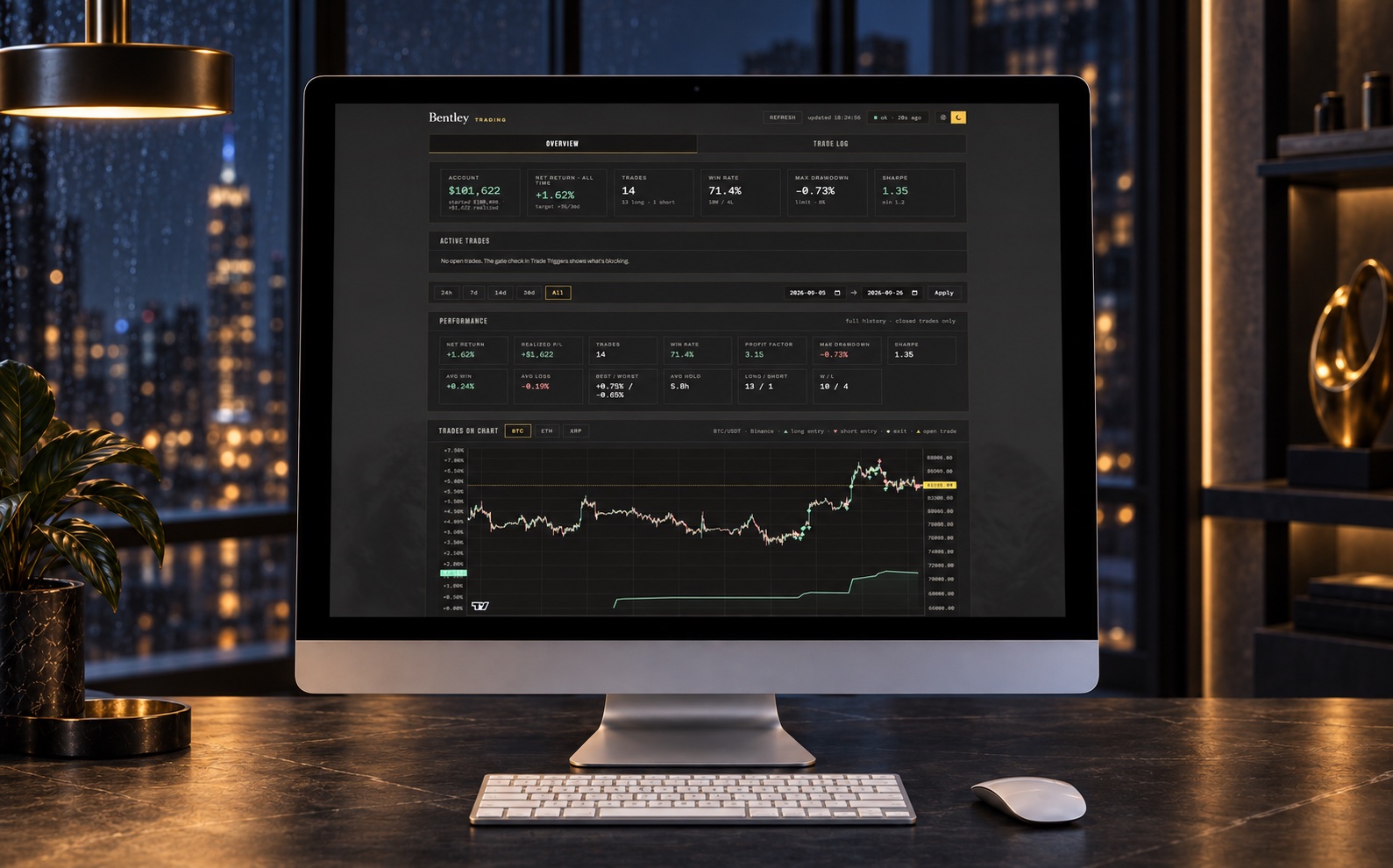
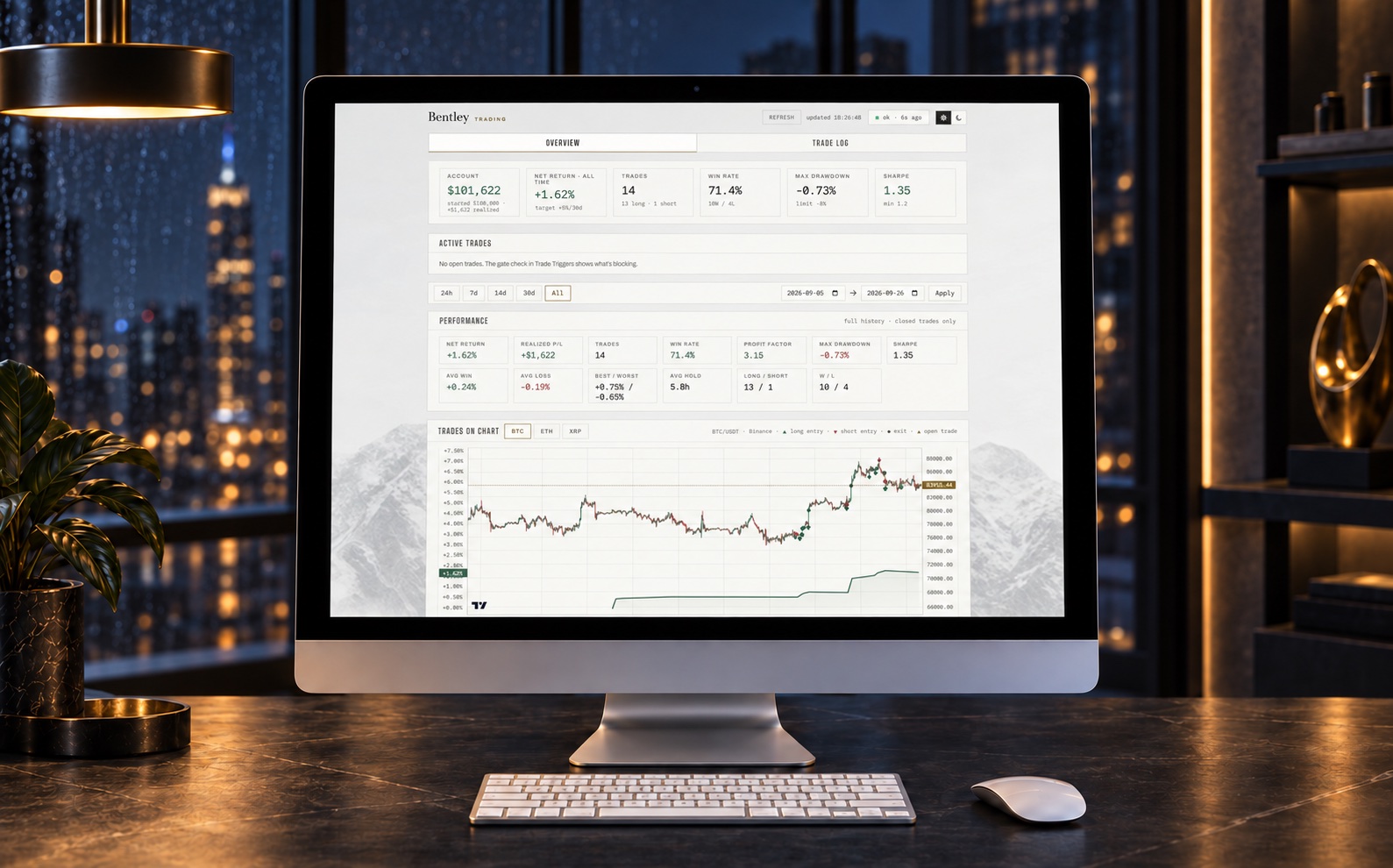
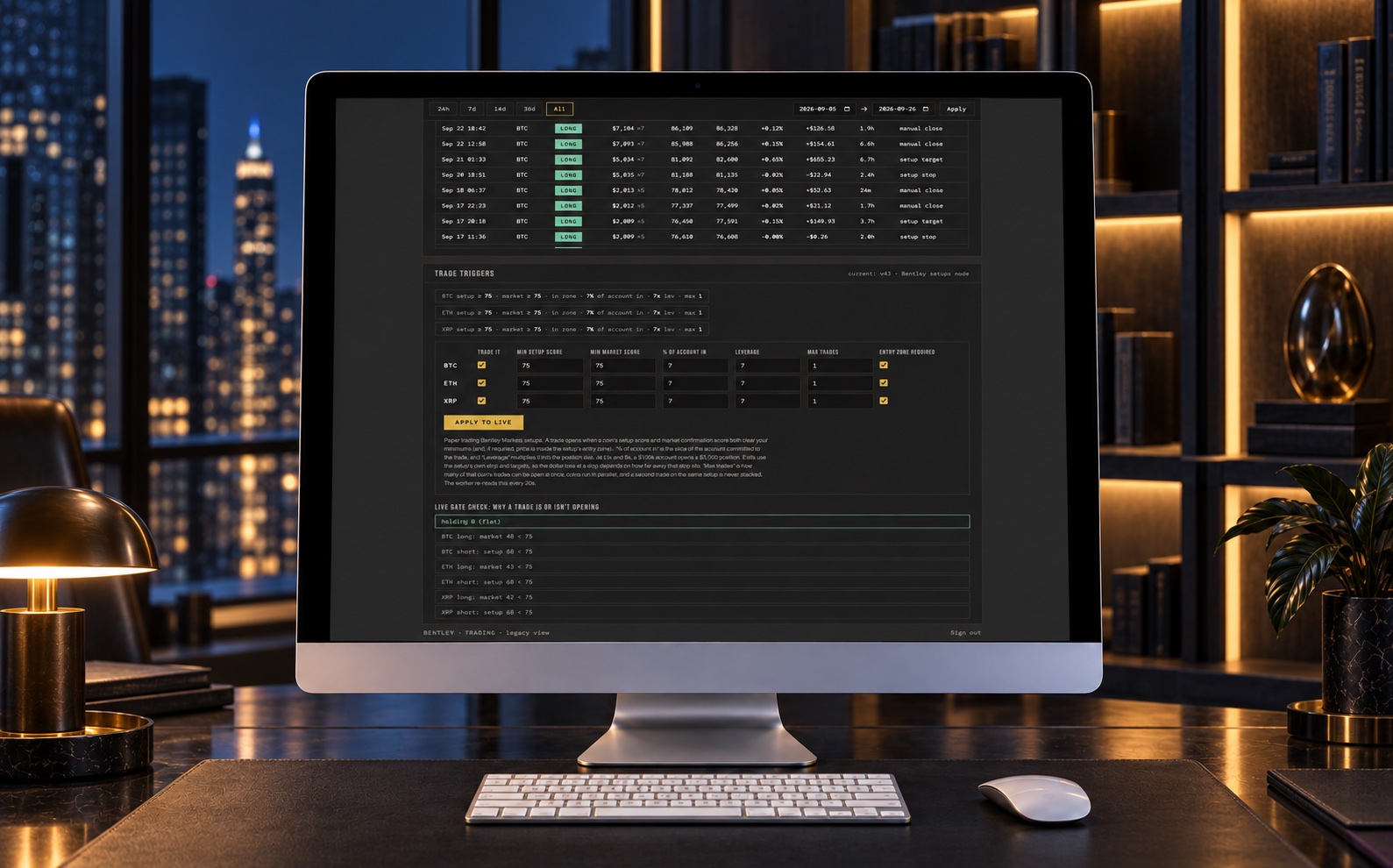
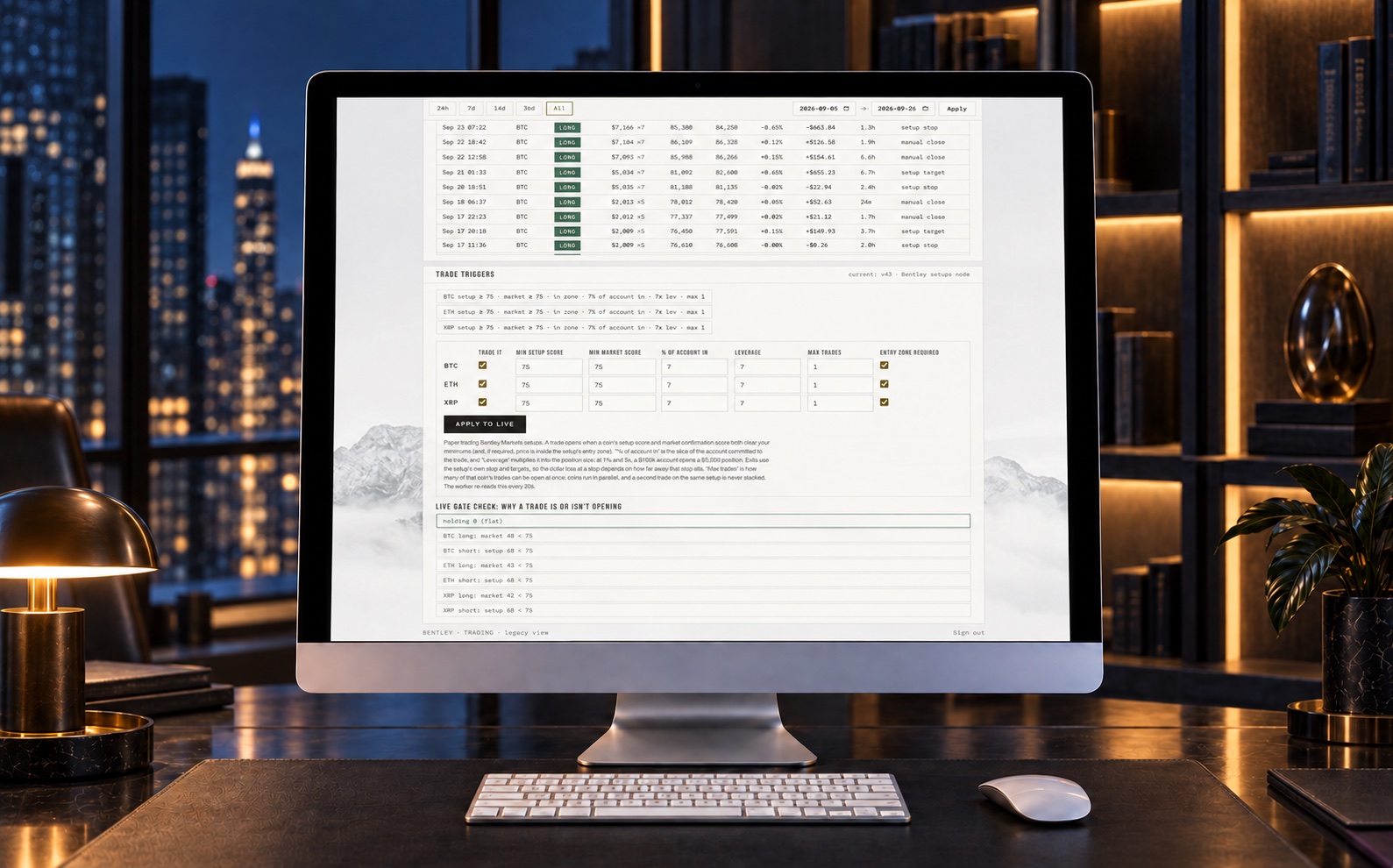
The trading side has its own deck. It shows the account, every trade on the chart with its entry and exit, and performance for any date range. Right now it runs a $100,000 paper account, filling simulated orders against live prices.
Trade Triggers is the control panel. Per coin I choose whether to trade it, the minimum setup score, the minimum market score, how much of the account goes in, the leverage and how many trades can be open at once. Apply to Live pushes the new rules to the worker, which picks them up within a minute with no restart.
Below it, a live gate check says in plain terms why a trade is or isn't opening, like "BTC long: market 48 < 75". Most of the time the honest answer is that nothing is good enough, and the tool should say that clearly rather than look broken.
Moving from test to live means giving Bentley an exchange API key. The setups, scores and rules stay exactly the same, so what I watched it do on paper is what it does with real money.
The Build
Bentley lives on a Linux server rather than a laptop, because a trader that stops when the lid closes isn't much of a trader. Everything on it restarts by itself after a reboot, and it is locked down to the few ports it needs.
The intelligence comes from Hermes, an open-source AI agent framework, set up with a persona called Bentley and its own skills for trading: strategy review, Elliott Wave analysis, market context and exchange access. Hermes runs on ChatGPT, using OpenAI's GPT-5.5, with a free fallback model so Bentley keeps working if that provider stalls.
Design System
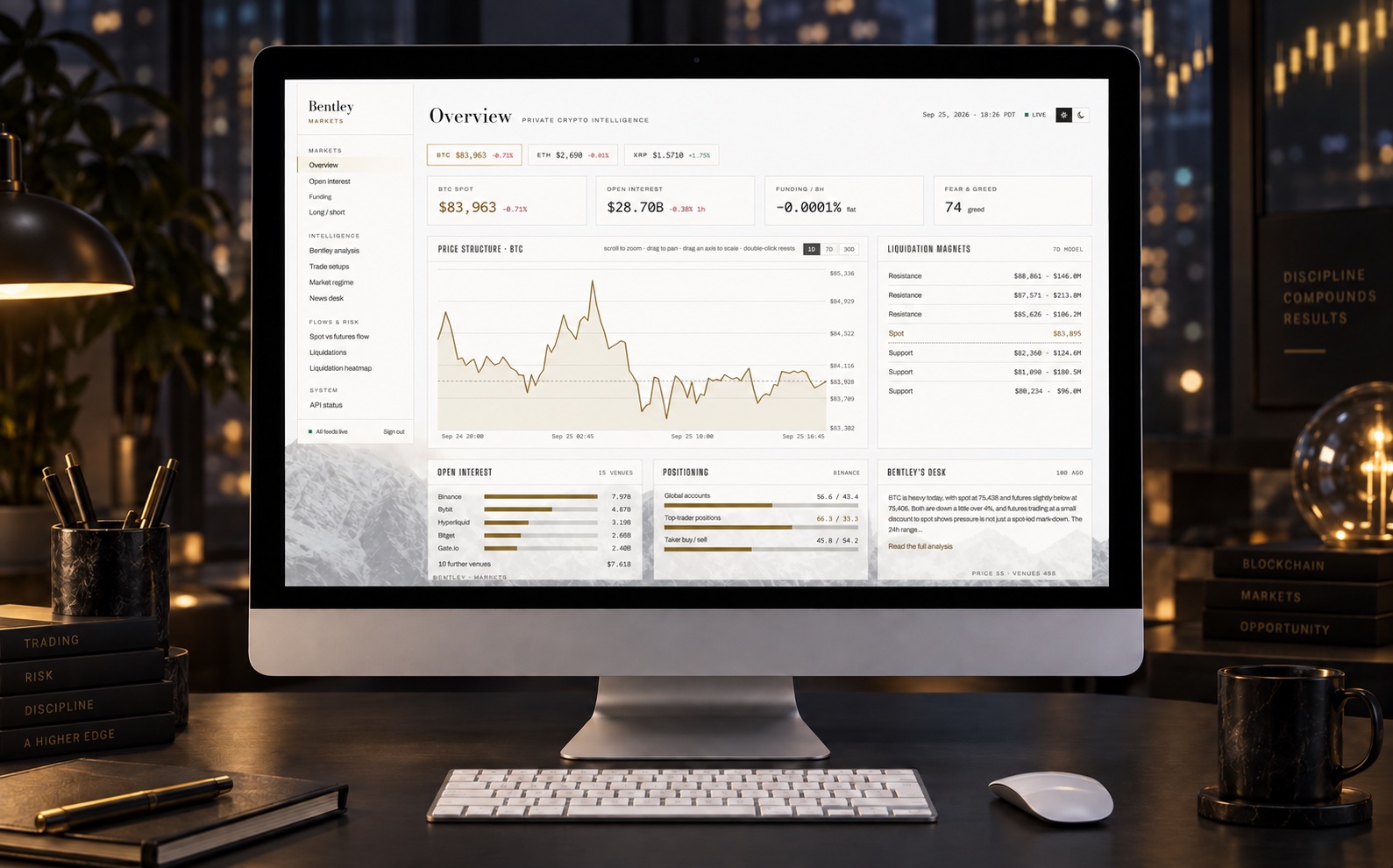
A trading screen is looked at for hours, often late at night, so the palette is warm and low: graphite, bone and a single gold that marks what is live or selected. Gains and losses use a muted green and red, strong enough to read and calm enough not to shout.
Type does the rest. Bodoni Moda for page titles gives it the feel of a private bank statement, Big Shoulders sets the section labels, Archivo carries the prose, and Red Hat Mono keeps every price in tidy columns. Both themes were designed together, and every image here can be flipped between them.
Graphite
#141311
Bone
#F0EDE5
Gold
#E5C87C
Gold on light
#695420
Up
#6FAE8F
Down
#D98585
Early Results
These come from the paper account since setup-driven trading began on 5 September 2026. Fourteen trades is far too few to call a strategy proven, and the tool is built to say so. The target it is held to is steady, realistic growth with drawdowns kept small, not a spectacular backtest.
14
Paper Trades
Closed
71%
Win Rate
10 Wins, 4 Losses
3.15
Profit Factor
on Paper
−0.73%
Largest Drawdown
Against an 8% Limit
Paper trading results against live prices. Bentley is a personal project, not financial advice.
Reflection
The hardest design problem was making "do nothing" look intentional. Most of the time no setup is good enough, and early versions just looked empty or broken. The gate check, the Entry missed chip and the regime's stand-aside call all exist to explain inaction.
Let the code do the maths and the model do the judgement. The setups got noticeably better once the server computed every indicator and the agent was only asked to reason about them, with its answer checked before anything acted on it.
More trades on paper before more money on the line. Once the sample is big enough to trust, the next step is running the paper account and a small live account side by side on the same setups, so any gap between simulation and real fills shows up straight away.